What happened
The Linux project moved from the 6.x line to 7.0. The first release candidate, 7.0-rc1, arrived on February 22, 2026. At this stage, the kernel is in active testing and bug fixing.
This matters, but we should separate two things. One is the version label changing from 6.x to 7.0. The other is the technical changes merged in this cycle, including early support work for new CPU families.
Simple analogy: changing a book from edition 6.20 to 7.0 does not mean every chapter was rewritten. Some chapters changed a lot, some changed a little, and some did not change at all.
Why version numbers matter
Version numbers help humans coordinate testing and release work. They also drive automation in CI pipelines, packaging scripts, and compatibility dashboards.
Linux kernel numbering does not map cleanly to strict semantic-versioning rules used by some app libraries. A major-number bump does not automatically mean user-space breakage. The stronger Linux contract is to avoid breaking user-space behavior.
The number still affects operations. Teams schedule validation by kernel line, and vendors align support statements to those lines. So the label is not just cosmetic, but it is not the same as a guaranteed compatibility break either.
Technical implications
Release engineering reality
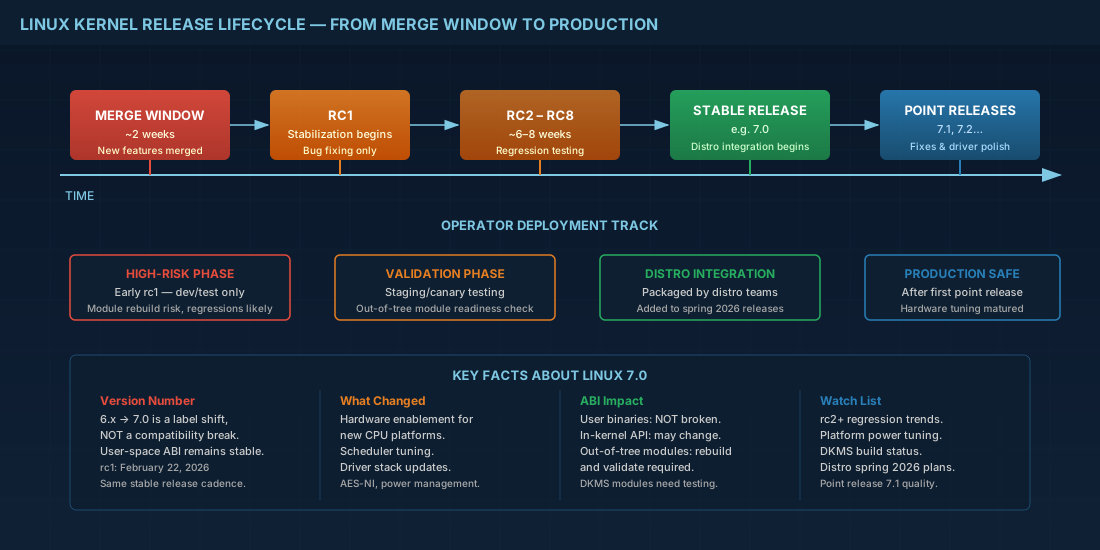
rc1 means the merge window closed and stabilization started. The following weeks focus on regressions, fixes, and confidence. Planned dates can slip if serious regressions appear.
Hardware enablement
Headlines mention enablement for newer CPU platforms. In practice, enablement comes in layers: basic boot support first, then scheduler tuning, then power and thermal polish. Early support can be good enough to run workloads while still needing optimization in later point releases.
ABI and API stability
Keep this split clear:
- User-space ABI stability is a core Linux expectation. Most applications continue to run across kernel upgrades.
- In-kernel APIs are not stable in the same way. Out-of-tree modules can break and may need updates or rebuilds.
That is why an upgrade can keep app binaries working while a third-party driver fails to compile until the vendor ships a patch.
Scheduler and driver behavior
New CPU generations often need scheduler policy adjustments for better task placement and power behavior. Driver stacks also need real-world testing under suspend/resume, mixed I/O, and long uptime. Functional boot success and production-grade stability are not the same checkpoint.
Real-world consequences
For entry-level technicians, the practical takeaway is simple: treat 7.0 like any major kernel transition. Test first, then deploy.
- Desktop users on older hardware may see small changes.
- Teams adopting brand-new hardware may get critical compatibility improvements.
- Enterprise operators should expect staged rollout, rollback planning, and module validation.
Tradeoff: early adoption gives faster hardware support, but usually carries higher regression risk during the first weeks of a new line.
What to watch next
- Regression trends from
rc2onward (boot, suspend, networking, storage). - Follow-up platform patches for performance and power tuning.
- Out-of-tree module readiness and DKMS build status.
- Distro integration decisions for spring 2026 releases.
- First point releases, which often reveal early-cycle pain points.
Glossary
Release candidate (RC)
A pre-release build used to validate stability before final release.
Regression
A bug where behavior that previously worked stops working or gets worse.
User-space ABI
The kernel interface contract used by applications; Linux generally keeps this stable.
In-kernel API
Internal kernel interfaces used by modules and subsystems; these can change between releases.
Backport
Applying a fix from newer code to an older maintained branch.
Conclusion
Linux 7.0 is important, but not because the number is larger. The real story is release quality, hardware enablement depth, and how quickly regressions are found and fixed. For production teams, disciplined validation still matters more than headline version numbers.